Music Theory
Table of Contents
- 1. Interval
- 2. Chord
- 3. Scale
- 4. Key
- 5. Mode
- 6. Chord Progression
- 7. Circle of Fifths
- 8. Tritone Substitution
- 9. Cadence
- 10. Element
- 11. Modal Interchange
- 12. Transposition
- 13. Rhythm
- 14. Instruments
- 15. Notations
- 16. Music Composition
- 17. References
1. Interval
1.1. 12 Tone Equal Temperament
- 12 TET
- The frequency of each note is \(\sqrt[12]{2}\) times the previous note.
1.1.1. Name of Intervals
- Minor 2nd
- Major 2nd
- Minor 3rd
- Major 3rd
- Perfect 4th
- Tritone
- Perfect 5th
- Minor 6th
- Major 6th
- Minor 7th
- Major 7th
- Octave
- Minor 9th
- Major 9th
- …
1.1.2. Dissonace
- Minor 2nd, Major 2nd, Tritone, Minor 7th, Major 7th, … are considered to be dissonant with different degrees.
- Tritone is at the exact middle of a scale, which enables Tritone substitution.
2. Chord
2.1. N
- Major chord.
- major 3rd - minor 3rd.
2.1.1. N7
- Dominant 7th chord.
- major 3rd - minor 3rd - minor 3rd.
2.1.2. NM7
- Or NΔ7
- Major 7th chord.
- major 3rd - minor 3rd - major 3rd.
2.1.3. N6
- Major 6th chord.
- N(add6)
2.1.4. N6/9
- Major 6 9 chord.
- N6(add9)
2.1.5. N9
- Dominant 9th chord.
- N7(add9)
2.1.6. NM9
- Or Nmaj9, NΔ9
- Major 9th chord.
- NΔ7(add9)
2.2. Nm
- Or n, N-
- Minor chord.
- minor 3rd - major 3rd.
2.2.1. Nm7
- Or N-7
- Minor 7th chord.
- minor 3rd - major 3rd - minor 3rd
2.2.2. NmM7
- Or N-Δ7
- Minor Major 7th chord.
- minor 3rd - major 3rd - major 3rd
2.2.3. Nm6
- Minor 6th chord.
- N-(add6)
2.2.4. Nm6/9
- Minor 6 9 chord.
- Nm6(add9)
2.2.5. Nm9
- Or Nmin9
- Minor 9th chord.
- N-7(add9)
2.3. Naug
- Or N+
- Augmented chord.
- N(♯5)
- major 3rd - major 3rd.
2.3.1. Naug7
- Or N+7
- Augmented 7th chord.
- N(♯5,♭7)
- major 3rd - major 3rd - major 2nd
2.4. Ndim
- Or No
- Diminished chord.
- N-(♭5)
- minor 3rd - minor 3rd
2.4.1. Nø7
- Half-diminished 7th chord.
- minor 3rd - minor-3rd - major 3rd
- N-(♭5,♭7)
2.4.2. Ndim7
- Or No7
- Diminished 7th chord.
- N-(♭5,♭♭7)
- minor 3rd - minor 3rd - minor 3rd
2.5. Nsus4
- Or Nsus
- Suspended 4 chord.
- N(omit3, add4)
- perfect 4th - major 2nd
2.6. Nsus2
- Suspended 2 chord.
- N(omit3, add2)
- major 2nd - perfect 4th
2.7. Extended chords
- One can extends every 7th chord by:
- (add 9) for 9th chord
- (add 9, 11) for 11th chord
- (add 9, 11, 13) for 13th chord.
2.7.1. Alterations
- Sharpening or flattening of extensions are possible in any combination.
- ♭9
- ♯9
- ♯11 (sometimes, ♭5)
- ♭13 (sometimes, ♯5)
2.7.1.1. N7alt
- Short for N7(♭9, ♯9, ♯11, ♭13). But one is to improvise with some of or all the altered notes.
2.8. Slash chords
- Written as N/M.
- Play N with M as the base note.
- If note M is in N, then it represents inversion.
- N could be the extension of M, in such case slash chord is used for notational convenience.
2.9. Polychords
- Play M with N on top of that.
- e.g. \[ \rm \frac{N}{M} \]
3. Scale
- Scale is to tell which note to use to not sound off.
3.1. Diatonic
- The notes are within the given scale.
3.2. Chromatic
- The notes are outside of the scale.
3.3. Common Scales
3.3.1. Major
3.3.2. Minor
- Or Natural Minor
- ♭VII, ♭III, ♭VI
3.3.3. C Minor Scale
| Note | Diatonic Chord |
|---|---|
| C | Cm |
| D | Do |
| E♭ | E♭ |
| F | Fm |
| G | Gm |
| A♭ | A♭ |
| B♭ | B♭ |
3.3.4. Harmonic Minor
- ♭III, ♭VI
- This is to preserve the leading tone, VII.
3.3.5. C Harmonic Minor Scale
| Note | Diatonic Chord |
|---|---|
| C | Cm |
| D | Do |
| E♭ | E♭+ |
| F | Fm |
| G | G |
| A♭ | A♭ |
| B | Bo |
3.3.6. Melodic Minor
- ♭III when ascending, ♭VII, ♭III, ♭VI when descending.
- This is because we don't need leading tone when descending.
- This is to remove the large gap between ♭VI and VII.
3.3.7. C Melodic Minor Scale
| Note | Diatonic Chord |
|---|---|
| C | Cm |
| D | Dm |
| E♭ | E♭+ |
| F | F |
| G | G |
| A | Ao |
| B | Bo |
4. Key
- The note that is the center of gravity.
- Think of a song as a dance around this key.
5. Mode
- Mode is a scale and a harmonic structure.
- C Ionian = D Dorian = E Phrygian = …
5.1. Ionian
5.2. Dorian
- ♭VII, ♭III
5.3. Phrygian
- ♭VII, ♭III, ♭VI, ♭II
5.4. Lydian
- ♯IV
5.5. Mixolydian
- ♭VII
5.6. Aeolian
- ♭VII, ♭III, ♭VI
5.7. Locrian
- ♭VII, ♭III, ♭VI, ♭II, ♭V
- Major isn't happy, Minor isn't sad - YouTube
6. Chord Progression
7. Circle of Fifths
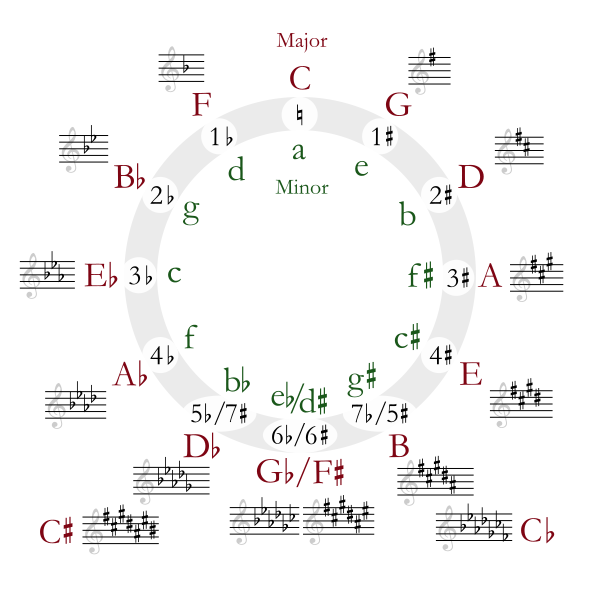
- It is related to the overtone series
- the notes with similar overtone series are placed nearby!
- This is the core idea of the circle of fifths.
- Why You Need to Learn Circle of Fifths Right Now - YouTube
- Major Triad
- Minor Triad
- Pentatonic Scale
- 4 levels of the Circle of Fifths - YouTube
- Key Signature Identification
- Key Similarity
- Chord Similarity
- Mode Darkness
8. Tritone Substitution
- Tritone Sub
- Songs that use Tritone Substitution - YouTube
- Use the tritone as a substitution.
- Usually the dominant seventh chords are substituted since they contain the identical tritones.
- It is the opposite chord in the 7
9. Cadence
- The end of phrase in which a full or partial resolution is achieved.
9.1. Jazz
- ii9 - V13 - I6/9
- Dm9 - G13 - C6/9
9.2. Pop
- I - V - vi - IV
9.3. Inspirational
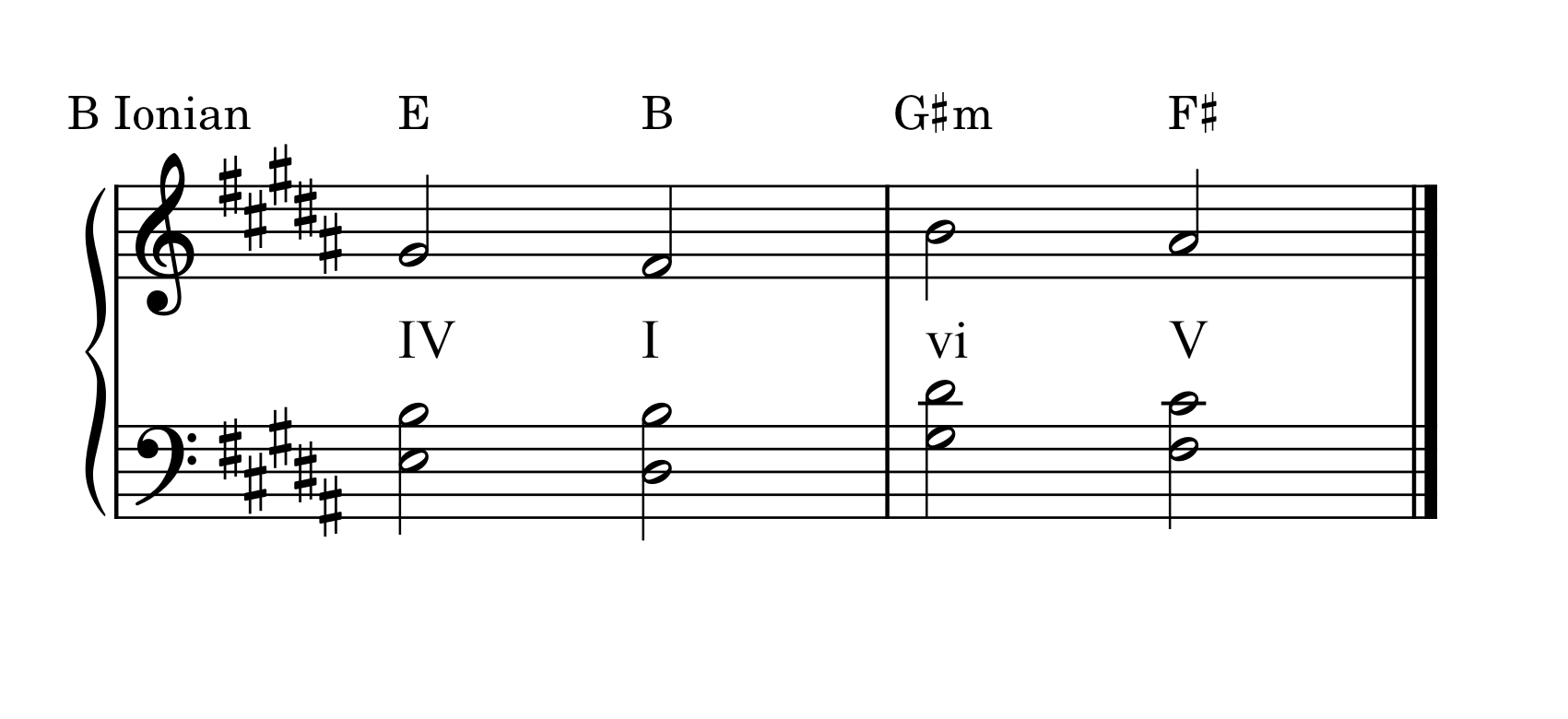
9.4. Andalusian Cadence
- vi - V - IV - III
9.5. Common Progression
- 1-5-6-4. C, G, Am, F.
- 6-4-1-5. Am, F, C, G.
- 1-4-5-4. C, F, G, F.
- 1-6-4-5. C, Am, F, G.
- 2-5-1-6. Dm, G, C, Am.
10. Element
10.1. Tune
- A piece of music
10.2. Phrase
- Few bars of idea
10.3. Riff
- The core idea of a tune
10.4. Lick
- Quick phrase that acts as an embellishment
10.5. Vamp
- Repeated chords
- Usually melody is played over it.
10.6. Ostinato
Corporate Music - How to Compose with no Soul - YouTube
- Persistently repetitive motif
11. Modal Interchange
It is a musical technique of temporarily changing 5 amidst a song.
12. Transposition
- Transposing a piece means to rewrite the piece in another key.
- How to Make a Musical Theme fit any Context - YouTube
- Change based on the position of the notes within a scale
- Change the notes based on the rises and falls of the intervals
- The notes on the weak beats are not essential for the motif.
- Insertion of Removal of notes are also possible.
13. Rhythm
Most rhythms don't have a recognized name
13.1. Son Clave
- Bo Diddley Beat
- Three Two Son Clave, Son Clave (3:2)
\version "2.26.0"
\paper { oddFooterMarkup = ##f }
\relative {
  \override Staff.Clef.stencil = ##f
  \override Staff.StaffSymbol.line-count = #1
  \numericTimeSignature
  \time 4/4
  \repeat volta 2 {
    \bar ".|:" b'4. b8~4 b4 | r b b  r |
  }
}
The version with bars exchanged is called Son Clave (2:3)
- It is from the Latin music
13.2. Tresillo
- Tresillo is spanish for triplet
\version "2.26.0"
\relative {
  \override Staff.Clef.stencil = ##f
  \override Staff.StaffSymbol.line-count = #1
  \numericTimeSignature
  \time 4/4
  \bar ".|:" b'4. b8~4 b4 \bar ":|."
}
Almost Triplet. Long(3) - Long(3) - Short(2). Especially common among 2010 pop music.
13.3. Rumba Clave

13.4. Standard African Bell Pattern

- Likely to have influenced the shuffle groove
13.5. Swing
- Whenever the eighth note is not evenly spaced, and the first ones are longer than the second ones.
- The swing ratio is the ratio between the long and short notes.
- Shuffle is 2 to 1 swing
13.5.1. Shuffle Groove

- Heart of the Blues, Jazz and later Rock music
- It is a rhythm in 12/8 where we emphasize the first and third eighth note in each beat
13.5.2. Scotch Snap
- Lombard Rhythm

- The name comes from the traditional Scottish music, and the Lombard comes from the baroque music.
- It is also heard form the modern R&B and hip-hop music.
13.6. Bossa Nova
- It makes use of various syncopated rhythms.

- Archetypal Bossa Nova
- 3 - 3 - 4 - 3 - 3
13.7. The Charleston
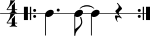
- Origianlly a song written for Charleston dance
13.8. Waltz
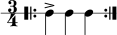
- Originally used for dancing
13.9. 5/4 Clave
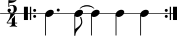
- Famously featured in Mission Impossible
13.10. Polyrhythm
13.10.1. 3:2 Polyrhythm
- Hemiola
- Nice Cup of Tea
13.10.2. 4:3 Polyrhythm
- Pass the god damn butter
13.11. Football Clap
- England Chant

- Shout England at the last two notes.
13.12. Shave and a Haircut, Two Bits

- Rhythmic Call and Response
- To give you a shave and a haircut, but not give you the two bits.
14. Instruments
14.1. Piano
- The center C is called C4
- My piano is tuned such that D4 = C4.
14.2. Double Base
- Contrabase?
- Low C Extension
- They can play even below the low C.
15. Notations
15.1. Time Signature
15.1.1. Common time
- Shorthand for 4/4.
\version "2.26.0"
\markup \pad-around #1 {
  \musicglyph "timesig.C44"
}
15.1.2. Cut time
- Shorthand for 2/2.
\version "2.26.0"
\markup \pad-around #1 {
  \musicglyph "timesig.C22"
}
15.2. Text
15.2.1. Rehearsal Mark
- \(\fbox{A}\)
- Letter A
- \(\fbox{\,1\,}\)
- Figure 1
- Used to divide a score into movements.
- It is useful for rehearsal.
15.3. History
Notation Must Die: The Battle For How We Read Music - YouTube
- François-Auguste Gevaert(1828-1908) classified the musical notations into two categories: Phonetic notation,
15.3.1. Phonetic Notation
- Chinese, Arabic, Hindi, Ancient Greek Notations.
- Jianpu: Contemporary Chinese System for simple melodies.
15.3.2. Western Notation
15.3.2.1. Neumatic Notation
- Started Out of Gregorian Chants to standardize its fragmentations across the continent.
- Neumes: Squiggles indicating the quality of the note.
15.3.2.2. Nonantolian Notation
- Northern Italy
- Single, and later double, horizontal lines with vertical lines indicating pitches.
15.3.2.3. Guido
- Guido made the nonantolian notation four horizontal lines, the staff lines, and placed neumes upon it. This system spread and it was standardized.
15.3.2.4. Mensural Notation
- Polyphony emerged, and the rhythms needed to be notated.
- Longa Brevis Semibrevis Minima Semiminima Fusa Semifusa
- There's many competing systems.
- Franco of Cologne introduced the prick of perfection that makes the brevis altera into brevis recta.
15.3.2.5. Standard Notation
- Modern Standard that is descendant of all of these.
16. Music Composition
- Melody is part of the harmony
16.1. Chord Voicing
16.2. Structure
16.2.1. Harmony
16.2.2. Form
- Such as sections
16.2.3. Narrative
- Mainly, the melody.